Sunday, July 22, 2012


Week 5: Orthographic into Isometric Projection


Topic: From Orthographic to Isometric Projection

Class: M4

School: Mont Roches Training centre

Date: 13/04/2012

Prior Knowledge: Orthographic/Isometric Projection

Duration: 75 minutes

Number of students: 20


Aim: 
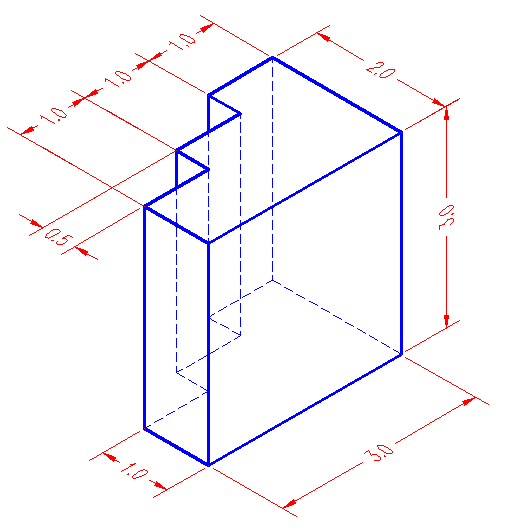
To teach students how to draw an object in isometric from 3 views given in Orthographic Projection- the crate.


Teaching Aids:

  1). Models/Charts in 3 views (orthographic).

  2). 3D Block

  3). Isometric/Square boards –marker of different colours.


Location: 
Theory classroom

Preparation: 3D card models (boxes) from toothpaste and perfume -Charts of simple Orthographic


Learning Outcomes
At the end of the lesson the students should be able to:

  • Differentiate between the different views in orthographic projection.
  • Differentiate between the various faces to convert into isometric.
  •           Draw crate in isometric from Orthographic views


Procedure 


Step 1:  (5 minutes)

Welcome students and gain their attention to start the class.

Take attendance of students 


Step 2:  (10 minutes)

Recapitulation on orthographic projection -the previous lesson.


Step 3 :  (10 minutes)

  Introduction to Isometric from orthographic views.

  Show chart and explain the three views in orthographic.


Step 4 :  (10 minutes)

- Explaining using teaching aids- the boxes.

- Draw the 3 views, front, top and side.

- Use of teaching aid 3D model brainstorming on the length, height and depth.

 - Draw and explain the angle 30 degrees in isometric.

-  Draw the complete crate.


Step 5:  (10 minutes)

Classwork 1 - copy explanation set on isometric and orthographic boards.


Step 6:  (10 minutes)

Checking and evaluating students work by walking around the class.


Step 7: (15minutes)

- Summarising the lesson by questioning.

- Class work 2 ask students to refer to their DT photocopy to do exercise on crate in Isometric Projection.

- The same work should be completed at home.


Week 4: Orthographic Projection


Topic: Orthographic Projection

School: Mont Roches training centre

Date: 11/06/12

Prior Knowledge: Lines and Orthographic/Isometric Projection

Duration: 80 minutes

Time: 1030-1145

Number of students: 20


Aim: 
To teach students how to draw the Front and Top views from an isometric block.


Teaching Aids:

  1). Marker of different colours

  2). Isometric grid Bristol paper

  3). Square grid Bristol paper
.
  4). Design and Technology- Book 1 (NCCRD)


 Location: Theory classroom


Preparation: 

1. Class setting
2. Drawings of one shaped block on isometric Bristol paper.


Learning Outcomes

At the end of the lesson the students should be able to:

  1. Read and write the three main dimensions; width, height and depth from an isometric   drawing.

  2. Draw the front and top views from a given isometric shaped block.


 Procedures


Step 1- (5 mins)
Welcome students and gain their attention to start the class.

Take attendance of students


Step 2- (15 minutes)

- Introduction to Orthographic Projection.

- Explain on specific uses of Orthographic Projection as for example in layout of a building

- Pupils' participation is encouraged by simple questions and answers.

Probable questions to pupils:

 Ø  Have you ever seen the building plan of your house?

 Ø  What is the position of blackboard and windows in your class.?


Step 3- (10 minutes)

Refer to the drawing of the isometric block and explain:

  1)  The position of the viewer

  2)  The two views- Front and Top views

  3)  The three main dimensions namely width, height and depth.


Step 4- (10 minutes)

Refer to the drawing of the isometric block and:

  Write the dimensions (W, H and D) on square grid board with the participation of the pupils. Draw the crate and add details of the front view according to dimensions-width and heightDraw the crate and add details of the top view according to dimensions-width and depth.

Stress on the drawing positions of the F.V and T.V.


Step 5- (15 minutes)

Class work 1 - copy explanation set on isometric and orthographic boards.

Checking and evaluating students work by walking around the class.


Step 7- (10 minutes)

Summarise the lesson by revisiting the topic covered. Homework - DT book 1 page 59 Number 2 and 4.


Week 3: Isometric Projection


Topic: 
Isometric Projection of shaped blocks with horizontal & vertical faces.

Class: M6

School: Mont Roches training centre

Date: 20/05/2012

Prior Knowledge: Drawing of Crate in Isometric projection.

Duration: 80 mins - (2 periods)

Time: 11.10 to 12.30

Number of Students: 30


Aim: 
To draw shaped blocks into isometric projection


Teaching Aids:

Whiteboard, isometric and orthographic grid boards.

Location: Theory classroom.

Preparation: Drawings on boards.


LEARNING OUTCOMES

At the end of the lesson students should be able to:
  1. Read dimension from Orthographic views.

  2. Draw crate in isometric according to the three dimensions in Orthographic projection.

  3. Insert details of other shapes in the crate.

  4. Draw dark lines to complete the final drawing of the shaped block.


PROCEDURE

Step 1:  ( l0 minutes)
  •  Welcome students in the class

  •   Take attendance of students


 Recall on previous lesson, 'drawing of the crate in isometric projection', questions students on:

  a) The three views in orthographic projection

  b) The name of three 3 dimensions

  c) The position and direction of the Length, Height and the Depth.


Step 2:  (25 minutes)

  •  Explain by referring to the three views, Front, Side, and Top views
  • Read and write dimensions with the participation of the students.
  • Draw the crate in isometric projection according to dimensions identified.
  • Distinguish the other horizontal and vertical faces (by labelling a, b, c and so on), which are not on the surfaces of the crate.
  • Add the other surfaces in the isometric crate; darken the visible edges to complete the drawing.

 Step 3:  (20 minutes)

   (a)  Ask students to copy the example set on the boards.
   (b)  Walk round the class to monitor students' work.
   (c)  Guide students who are facing in difficulty.
   (d)   Correct the work of students who have finished.


Step 4:  (10 minutes)

Summing up of the lesson by asking a few questions to the students to test their level of comprehension of the topic.


Step 5:   (15 minutes)

 - Students are given an activity.

 - Students have to refer to their photocopy (DT –given to them prior) to practice numbers1&2.

 The same task has to be completed at home if they do not finish it by the end of the class. 
Walk around to see progress of work.


Week 2: Types of  Screws


Date:.24.09.2011


Learning area: Design and Technology

Class: Foundation class

Teacher: Desire L’olive

No. of students in class: 18

School: M.I.T.D Foundation Training Centre

Time:

Topic: Type of screws

Duration: 50 mins


Aims
Students must be aware of the existence of 4 different types of screws, its uses and material it is made of.

Objectives:

At the end of the lesson students should be able to

  1. Name the five different parts of a screw.
  2. Identify the four different types of screw.
  3. Name the three different types of slots.
  4. List advantage among the three types of slots which are provided on the head of screws.
  5. List material from which screws are mad.

Pre-requisite knowledge:
  1. Uses of screw in our environment
  2. Type of screws they have come across.


Teaching aids:
  1. The 4 type of screw.
  2. Screwdriver both flat and posidrive.
  3. Piece of wood and g- clamp

Classroom layout:
The instructions will be delivered to the whole class. Each student will take his own seat with all their required materials and learning tools. There will be rows of seats which will be spaced to facilitate movement of the teacher and the individual questioning of the students.


Methodology:
(a)    Oral questioning and answers
(b)   Visualizing
(c)    Demonstration
(d)   Explanation
(e)    Observation
(f)    Chalk and talk
(g)   Identification
(h)   Handling

Techniques and Activities:
For this lesson, I will use the inductive reasoning to implement my lesson. The students will be allowed to scrutinize, as far as possible, all related areas of the topic.
Activities will include visualizing, touching, writing, research, handling, discussions etc. During the on going of the lesson, oral questioning of individual students will be done to ascertain that learning is taking place. This, on the other hand will promote student participation (learner involvement).  
Implementation


Procedures:

Step 1:
a) introduction  on type of screws.
b) Different part of a screw
 Answer expected: shank, head because some similarities with nail.     (10mins

Step 2:
(a)    Visualizing of pictures, flip charts
(b)   Handling, touching available pieces of screws available in the class.  (5mins)

Step3:
(a) Explanation on different type of screws
(b) Explaining to students that we are more commonly use with countersunk screws than the other type.                                                                                                          (10mins)

Step 4:                                                         
a) Explain the different of slot
b) Advantages among them                                              (5mins)

 Step 5:
a) Material from which screws are made                           (3mins)

 Step 6: 
a) Recapitulation of the lesson                                          (5mins)


Evaluation

  1. Label 3 different parts of a screw ( 6 marks)
  2. Name the four different types of screws ( 8 marks)
  3. Name the two materials fr4om which screws are made of. ( 4 marks)
  4. Give three types of slot found on the head of screws ( 6 marks)


Week 1: Name and uses of Materials


Week 1: Names and Uses of Materials


Date: 05.08.2011


Learning area: Design and Technology

Class: Foundation class

Teacher: Desire L’olive

No. of students in class: 18

School: M.I.T.D Foundation Training Centre

Time:

Topic: Name and uses of Materials

Duration: 50minutes


Aims
Students must be aware of the existence of materials and be able to list down some uses.

Instructional objectives:
At the end of the lesson, the learner should be able to
    (a)    List the names of common materials in the immediate environment
    (b)    State some uses of each material.

Pre-requisite knowledge:
(a)    Some pupils know that different materials are used for constructions purposes.
(b)   Students are able to name one or two materials.
(c)    Students are able to identify one or two basic materials.

Tools and teaching aids:
(1) Whiteboard
(2) Pictures
(3) Available object brought from the workshop

Classroom layout:
The instructions will be delivered to the whole class. Each student will take his own seat with all their required materials and learning tools. There will be rows of seats which will be spaced to facilitate movement of the teacher and the individual questioning of the students.

Methodology:
(a)    Oral questioning and answers
(b)   Visualizing
(c)    Demonstration
(d)   Explanation
(e)    Observation
(f)    Chalk and talk
(g)   Identification
(h)   Handling
(i)     Writing and reading


Techniques and Activities:
For this lesson, I will use the inductive reasoning to implement my lesson. The students will be allowed to scrutinize, as far as possible, all related areas of the topic.
Activities will include visualizing, touching, writing, research, handling, discussions etc. During the ongoing of the lesson, oral questioning of individual students will be done to ascertain that learning is taking place. This, on the other hand will promote student participation (learner involvement).  
   

Procedures:

Step 1 :
  • Recall

   (a)    Explanation on the different types of materials.
   (b)   Listing down of already known materials

Answers expected:
There are many materials: metals, wood, plastic…….etc


Step 2:
  (a)    Visualizing of pictures, flip charts
  (b)   Handling , touching available pieces of materials and objects available in the class
 (c)    Listings down on the whiteboard as many materials as possible (metals, wood, plastic, concrete, ceramic, stone, glass, fabric etc.


Step3:
(a) Explanation on different uses of the listed materials.
(b) Explaining to students that we are surrounded by many materials (objects, artefacts, vehicles, buildings, etc).

Step 4:                                                          
(a)    Group work is carried out for identification of available materials.
 Listing down of the uses of different materials on Bristol paper

 Step 5: Class-work:


Evaluation:
Correction of class-work and feedback given
Remedial work:
Individual work is carried out as students are asked to write all materials they know on paper and submit.

Home-work:
1: Students are asked to find pictures of different objects, made of different materials, and do collage work on Bristol paper.


IMPLEMENTATION STAGE

Different strategies can be used to implement this lesson. All these strategies, inductive, deductive etc, have shared vision for a common goal; the most effective and efficient style or a method that I can present the subject matter in order to maximize the student learning capability. For this lesson I used the inductive method compared to traditional teaching strategies. Inquiry strategies, problem based-solving, discovery learning is the different instructional method that I used to implement my lesson.
For this particular topic, I decided to use two inductive teaching methods, namely inquiry based learning and discovery learning.


The steps I followed to conduct my lesson are explained.

Step 1 (3mins)
The word material was written on the whiteboard.


Step 2 – 8 mins
Students were allowed to think individually about the word for five minutes, with word related to material written on their copybooks. I walked around during those five minutes to have a glance at their work. This part of the lesson was intended in order to allow those students, with many learning difficulties to develop their thinking skills. Words written by the students included macadam, ferraille, tournevis, marteau, ciment, clou etc

Step 3 – 10mins
A precise explanation was given  on the blackboard of the word material, supplemented by pictures, flipchart, magazines and real small objects (compass, match box, glass, toilet paper, calculator, gravel, newspaper etc)    brought by me.

Step 4 – 10mins
 Students were directed to write all notes on their copybooks and to reflect on them for questioning. At this stage of the lesson I told students to relate what have been learnt to their immediate environment. I also asked the students how much time they needed to carry this task so as to allow them to grasp all relevant information.  
I used this approach of mutual agreement, so as to boost the confidence, responsibility and trust towards the teacher, of the students.

Step 5 – 10mins
Then I asked students to direct any question to me in order to clarify any point, word, or materials of the lesson so far conducted. This was carried out by the students raising their hands and the teacher attending one by one. The method employed was oral questioning, oral answering, visualizing, and handling.